Protein therapeutics have transformed medicine, yet their reach remains largely confined to extracellular targets. Delivering intact, functional proteins across the plasma membrane and into the cytosol or nucleus of mammalian cells would open routes to enzyme replacement, genome editing, and disruption of intracellular protein-protein interactions that conventional drugs cannot address. Existing approaches each carry trade-offs: linear cell-penetrating peptides, CPPs, suffer from endosomal entrapment and poor metabolic stability; cyclic CPPs achieve high efficiency but require chemical synthesis and post-translational conjugation; the zinc-finger miniprotein ZF5.3 is genetically encodable but depends on Zn2+ for folding and may force cargo unfolding during endosomal escape. Lipid nanoparticles and viral vectors show limited biodistribution beyond the liver. A genetically encodable, proteolytically stable, and broadly tissue-accessible delivery scaffold has remained elusive.
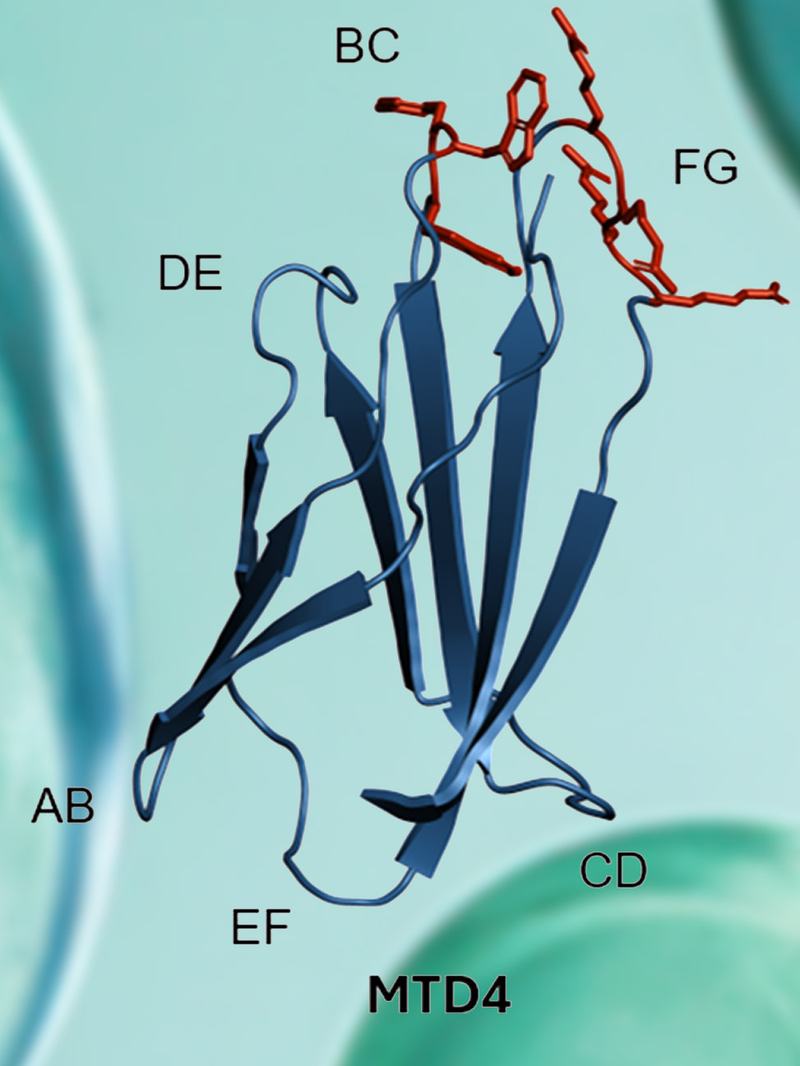
Researchers in the Pei Lab at The Ohio State University, published in ACS Chemical Biology, engineered a family of membrane translocation domains, MTDs, by grafting amphipathic CPP motifs into the solvent-exposed loops of the tenth fibronectin type III domain, FN3, from human fibronectin. The 94-amino acid FN3 scaffold folds spontaneously, contains no cysteines, expresses efficiently in Escherichia coli, and carries low immunogenicity risk because of its human origin. Five MTD variants were designed by replacing loop sequences with combinations of arginine and tryptophan or tyrosine residues chosen to generate the negative Gaussian membrane curvature required for vesicle budding-and-collapse endosomal escape. MTD4, which places a WYW hydrophobic motif in the BC loop and an RRRR cationic motif in the FG loop, proved the most potent and was characterized in depth.
Live-cell confocal microscopy of HeLa cells confirmed that MTD4 labeled with tetramethylrhodamine at a single C-terminal cysteine produced diffuse fluorescence throughout the cytoplasm and nucleus, with a Mander's overlap coefficient of only 0.04 against an endolysosomal dextran marker, compared with 0.85 for the unmodified FN3 scaffold. A NanoLuc luciferase complementation assay using an 11-residue HiBit peptide fused to each carrier quantified cytosolic delivery efficiency in HEK293T cells. At concentrations of 0.15 μM and below, MTD4-HiBit outperformed the cyclic CPP CPP12 by 12-fold and the linear CPP Tat by 14-fold. A serum-stability-optimized variant, MTD4s, achieved a half-life exceeding 24 h in human serum after removal of two proteolytic sites identified by mass spectrometry. MTD4 transported cargo in the folded state: a noncovalent MTD4-HiBit/LgBit-mCherry complex entered HeLa cells with only 23% colocalization with endolysosomal compartments, confirming that MTD4, LgBit, and mCherry all remained folded during translocation.
Functional delivery was validated across three distinct biological applications. Fusion of MTD4 to the 35-kDa catalytic domain of protein tyrosine phosphatase 1B reduced global phosphotyrosine levels in HEK293T cells with an EC50 of approximately 5 nM. MTD4-RBDV, a fusion with an optimized Ras-binding domain variant carrying a KD of approximately 3 nM for HRas, inhibited KRas-Raf interaction in a bioluminescence resonance energy transfer assay and reduced viability of six Ras-mutant cancer cell lines with IC50 values between 1 and 5 μM. For a therapeutic protein application, fusion of human argininosuccinate lyase to MTD4 restored enzymatic activity in argininosuccinate lyase-deficient patient-derived fibroblasts and, after intravenous administration in mice, distributed broadly to liver, kidney, lung, heart, and spleen within 4 hours, with high-magnification confocal imaging showing diffuse cytosolic signal across most cells in each tissue.
The MTD platform addresses several persistent limitations simultaneously. Because MTD4 binds membrane phospholipids rather than cell-surface receptors, it accesses a wide range of cell types and tissues, including plant cells as demonstrated in a companion study. Its genetically encodable nature allows recombinant fusion to the N- or C-terminus of any cargo without post-translational modification, and cargos ranging from 0.1 to 260 kDa with isoelectric points from 5.7 to 11 have been delivered. The authors note remaining challenges: MTD4 does not protect cargo from proteolytic degradation, and cytosolic aggregate formation during endosomal escape represents a bottleneck shared with other intracellular delivery systems. Strategies under investigation include PEGylation or PASylation to extend serum half-life and reduce renal clearance. The combination of low-nanomolar potency, metabolic stability, broad tissue penetration, and simple recombinant production positions the MTD platform as a candidate delivery vehicle for enzyme replacement therapies, intracellular biologics, and research tools targeting previously inaccessible cellular compartments.